Ellipsoidal Lightcurve
Implementation of the light curve generated by spinning ellipsoidal object. The apparent reduced magnitude of the object (that is, the magnitude after the traditionnal geometric effects have been taken into account: distances and phase angle), has a high frequency term added to it, corresponding to varying projected area of the object on the plane of the sky. It is based on the [Connelly & Ostro(1984)](https://ui.adsabs.harvard.edu/abs/1984GeDed..17…87C/abstract) model.
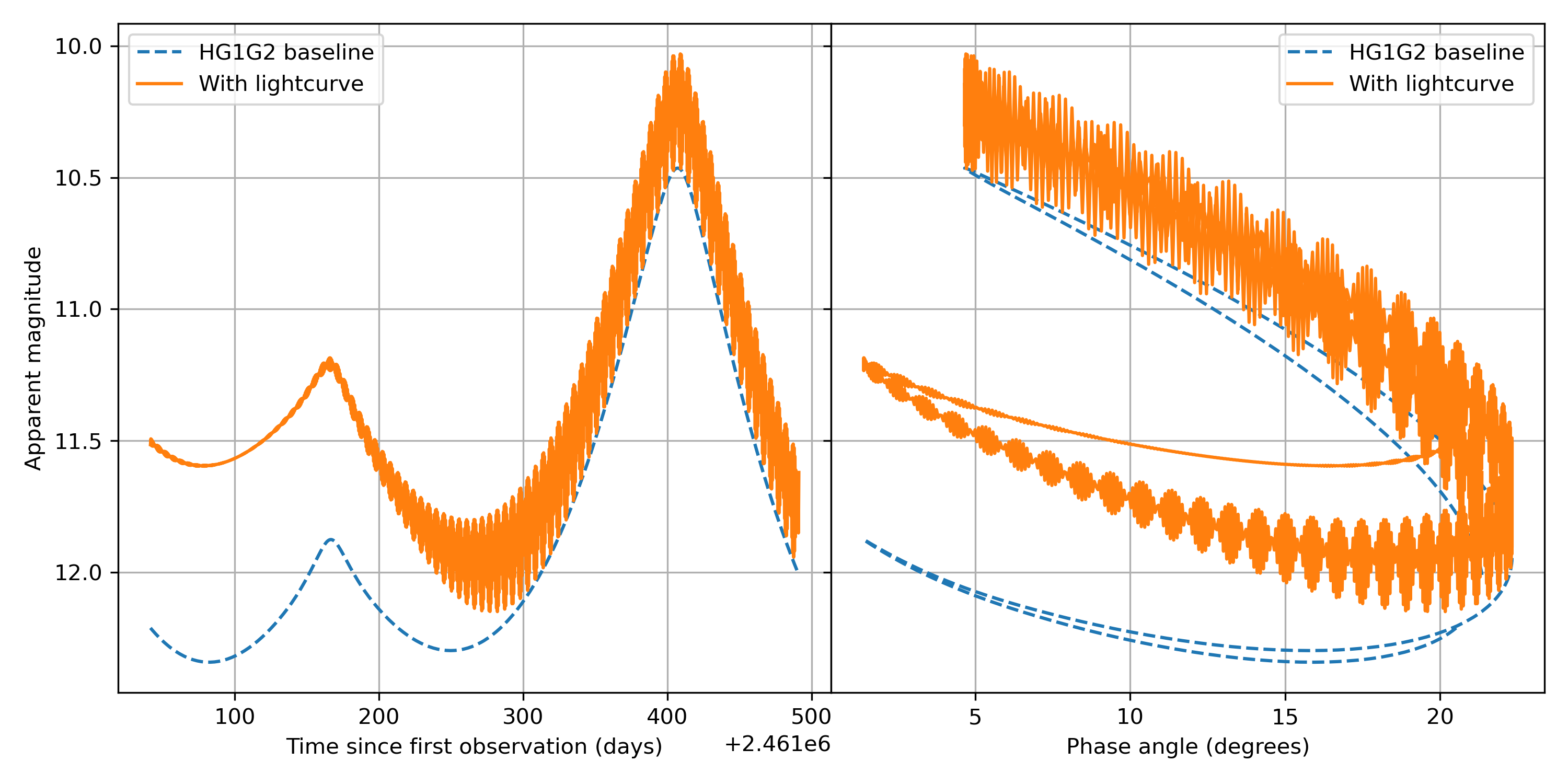
To use this function, in the Sorcha complex parameters file the user must provide:
FieldMJD_TAI: the time of observation [MJD] in the observer-centric time frame,Range_LTC_km: the distance to target at time of observation [km],RA: the target right ascension [deg],Dec: the target declination [deg],Period: : the target sidereal rotation period [days],Time0: : the reference time for the rotation [MJD],phi0: the longitude of the prime meridian at the reference time [radians],RA0: the right ascension of the target’s spin axis [radians],Dec0: the declination of the target’s spin axis [radians],a/b: the ratio of targets’ equatorial diameters [unitless],a/c: the ratio of target’s longest equatorial to polar diameters [unitless],
For details on the defitions of the rotation parameters (in particular Time0 and phi0),
see
[Archinal et al. (2018)](https://ui.adsabs.harvard.edu/abs/2018CeMDA.130…22A/abstract)
and/or
[Introduction aux éphémérides et phénomènes astronomiques](https://isbnsearch.org/isbn/9782759824144) (in French).
A simple demonstration Example Jupyter Notebooks is provided to illustrate the use of the EllipsoidalLightCurve class built into the ``Sorcha add-ons``package. To use this prescription, the lc_model variable should be set to ellipsoidal in the Sorcha configuration file.